


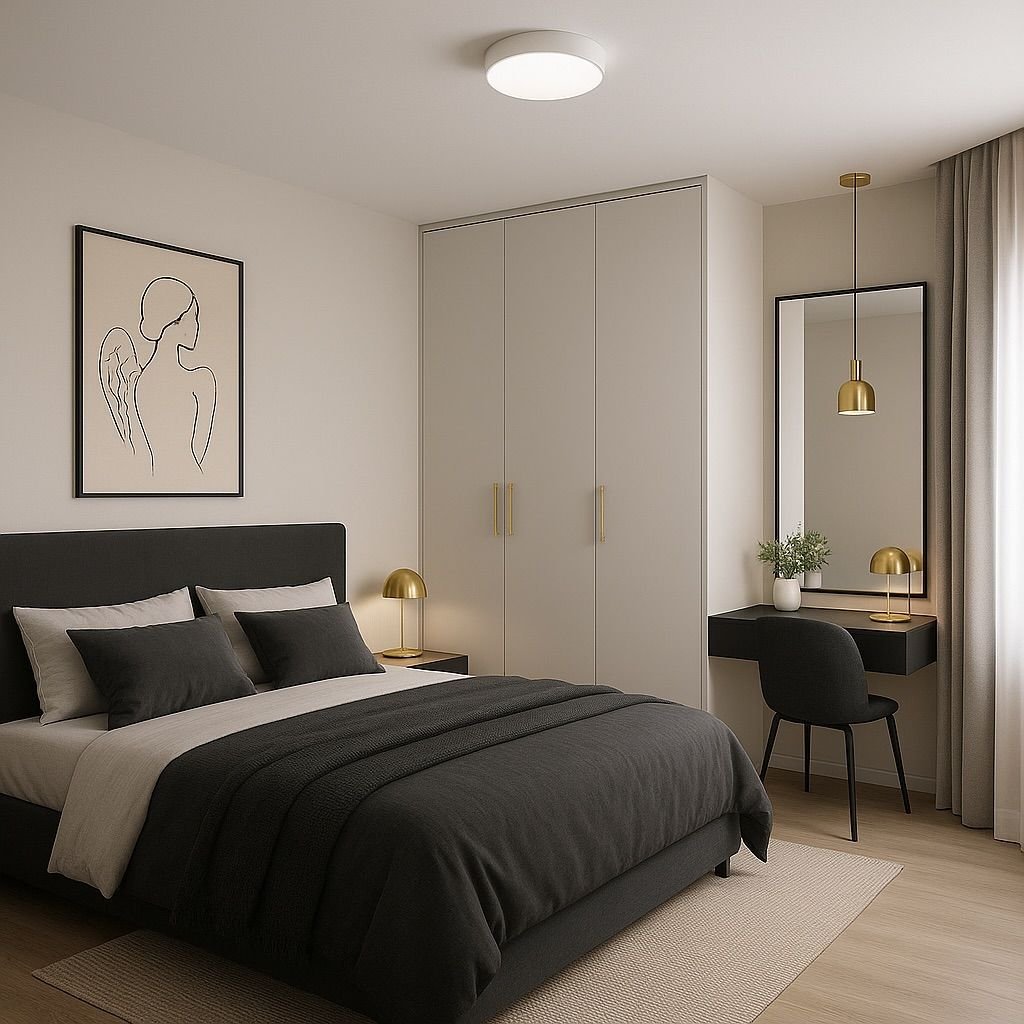
For the first eight months in my city apartment, I got into bed from the foot of it. The bedroom is 10 by 11 feet, the bed only fit one way, and the door swung into the frame with about four inches to spare, so shuffling in sideways was my only option. I told myself it was a quirk of living small until my sister walked in, looked at the room for about five seconds, and said, “You know you can turn the bed, right?”
I could. It cost nothing and changed how the whole room felt. Most of the small bedroom decor ideas I’ve kept since then are like that: not glamorous, a little embarrassing in hindsight, and based on figuring out what the room was actually struggling with, whether that was floor space, storage, light, or plain visual noise.
Below are 25 small bedroom decor ideas, ordered roughly from the stuff that solves real problems (layout, storage, closets) to the stuff that makes the room look good once those problems are solved (paint, lighting, styling). I’ve put prices where they matter, flagged what failed for me, and kept everything renter-friendly unless I say otherwise. There’s a cost breakdown and a FAQ at the end too, because I get the same questions in my inbox every month.
1. Start With the Layout: Where the Bed Goes Decides Everything
A bed takes up more of a small bedroom than every other piece of furniture combined, so its position determines your walking paths, where a dresser can live, and whether the door fully opens. Sort the layout out before you buy a single new thing, because no amount of decor fixes a room you have to sidestep through.
Use painter’s tape to mark the bed’s footprint on the floor (a queen is 60 × 80 inches, a full is 54 × 75) and mark the door swing while you’re at it. Live with the tape for a day. Aim for at least 24 inches of clear walkway on the side you get in and out from; you can get away with 18 on the other side.
The real trade-off is corner versus center. Pushing the bed into a corner frees up a whole wall for a dresser or desk, but one person has to climb over the other, which is fine solo and irritating for couples. Centering the bed on the short wall gives you symmetry and two nightstand spots but eats the floor. In my room the corner won, and it opened up enough space for a proper dresser.
Pro tip: Tape out the bed and every drawer and door that has to open. The layout that looks right on paper often fails because a dresser drawer clips the bed frame.
2. Choose a Storage Bed Frame That Fits Your Room, Not Just Your Stuff
Small bedroom storage ideas usually start under the bed, and a frame with built-in storage can save you from buying a second dresser. The type matters more than people realize, though, because a drawer you can’t fully open is just a decorative panel.
Drawer beds need roughly 18 to 24 inches of clear floor next to them to slide out. Hydraulic lift beds raise the whole mattress platform and open a single big cavity, which suits tight rooms better, but you do have to take everything off the bed to get in there. I’d pick lift storage for any room under about 10 × 10, and drawers if one side of the bed has breathing room.
| Storage option | Typical cost | Storage space | Floor clearance needed | Best for |
|---|---|---|---|---|
| Drawer platform bed | $400–$1,000 | Medium, easy access | 18–24 in beside the bed | Rooms with one open side |
| Hydraulic lift bed | $450–$1,200 | Large, one big cavity | Very little | Tight rooms, bulky bedding and luggage |
| Platform bed + rolling bins | $150–$400 | Medium | Reachable edge | Renters, budget builds |
| Standard frame + risers + lidded bins | $60–$150 | Medium to large | Reachable edge | Cheapest start with a bed you already own |
Prices are rough ranges and swing a lot by retailer and mattress size, so treat them as a budgeting guide, not a quote.
3. Use Under-Bed Storage for Things You Touch Less Than Monthly
The mistake I made first was stuffing the space under my bed with whatever didn’t have a home, which turned it into a junk drawer I was afraid to look into. Under-bed storage works when it holds a specific category: off-season clothes, extra bedding, shoes you rotate, or a suitcase.
Shallow lidded bins with wheels are the easiest version, and vacuum bags help with bulky sweaters and comforters. If your frame sits low, bed risers add 6 to 8 inches of height for around $20 to $30 a set, which is often enough to fit standard bins. A reader named Dana told me she labels each bin with a sticker on the short end, since you only ever see that end, and I stole that immediately.
The trade-off with risers is that a taller bed makes a low ceiling feel lower and can look top-heavy in a very small room. Check how it looks before you commit to the full 8 inches.
Pro tip: Buy bins with lids. Open bins under a bed collect dust faster than you’d think, and you’ll be sneezing into your pillow within a month.
4. Swap Nightstand Lamps for Wall-Mounted Sconces
Source
Okay, I’m going to go big on this one, because plug-in wall sconces were the single best $40 I spent on this room. A lamp plus a nightstand to hold it takes up a good square foot or two of floor and surface, and a sconce gets the light off the table entirely, so you can use a much smaller surface for just your phone and water.
Get plug-in sconces with a swing arm so you can aim the light for reading, mount them roughly 50 to 55 inches from the floor (adjust for your mattress height and how you sit up in bed), and run the cord down inside a paintable cord cover, which costs about $10. Two sconces and two covers ran me around $90 total.
For renters, they’re just two screws per sconce. When you move out, a $5 tub of spackle and a dab of touch-up paint handles the holes. Hardwired sconces look cleaner but need an electrician, so I’d skip them unless you own the place.
5. Replace the Nightstand With a Floating Shelf or a Stool
Source
If a full nightstand crowds your walkway, a shelf at mattress height does the same job in about a third of the space. Aim for a shelf 6 to 8 inches deep and 18 to 24 inches wide, mounted at roughly the height of your mattress top or a few inches above it.
Here’s where I messed up. I mounted my first one with drywall anchors alone, and within a month it sagged under a water glass, a lamp, and three paperbacks. Find a stud, or use heavy-duty toggle anchors rated well above what you’ll put on it. If you can’t drill at all, a small stool or a narrow side table with legs works fine and keeps your floor visible.
6. Make a Small Bedroom Look Bigger With the Right Light Paint Color
Source
Paint is the cheapest way to change how big a room feels, and it’s where people most often pick the wrong shade. Stark builder white tends to look cold and flat in a small room; a soft white, pale warm gray, or a muted greige with a little warmth reads as airy without feeling clinical.
Sample on two different walls and look at them in the morning, at midday, and at night with your lamps on. My friend Mia repainted her rental’s closet doors twice before landing on the right white, because it turns out “white” has about forty undertones and hers kept going faintly pink after dark. A $6 sample pot teaches you that more cheaply than a gallon does.
If you’re renting, check your lease first, and ask your landlord in writing. Many will allow it if you agree to repaint before you leave, and some will even cover the paint.
Pro tip: Painting the trim, baseboards, and even the door the same color as the walls blurs the edges of the room, which makes the walls feel like they extend further. Use a satin or semi-gloss on the trim so it still wipes clean.
7. Try Going Dark on Purpose (Color Drenching a Small Bedroom)
Source
This one sounds backwards, but a deep color on the walls, trim, and sometimes the ceiling can make a small bedroom feel cozy instead of cramped, because the corners stop being visible and the room reads as one enclosed shape. Color-drenched bedrooms have been all over Pinterest and design magazines for the last couple of years, and a dark bedroom is the version that actually works, since you mostly use the room at night.
I painted my first apartment’s bedroom a deep green and it looked wonderful, but I used a flat finish and every scuff from every suitcase stayed forever. Go with eggshell or satin on the walls, even though it shows a bit more light. Dark paint also needs good lighting, which ties into ideas 4 and 9 below.
The trade-off is real: going back to white later takes primer and two coats, and a north-facing room with a small window can feel gloomy rather than moody. If you’re not sure, try a mid-tone like sage or dusty blue first.
8. Use a Large Mirror to Bounce Light Around
Source
A big mirror is one of the oldest tricks for making a small space look bigger, and it works, but placement is what separates helpful from awkward. Put it opposite or at an angle to your window so it reflects daylight and visually doubles the view.
A leaning floor mirror, around 65 × 22 inches, runs about $60 to $150 and doesn’t need any wall damage. What it reflects matters: a mirror facing a messy closet just gives you two messy closets. I also wouldn’t put one directly facing the bed, because catching your own face at 6 a.m. is nobody’s favorite start to the day.
9. Layer Your Lighting Instead of Relying on the Overhead
Source
A single overhead light is the fastest way to make a small bedroom feel like a waiting room. Three layers fix it: the overhead for general light, a task light for reading (your sconce, from idea 4), and a small accent source like a warm LED strip or a little table lamp on the dresser.
Swap every bulb to a warm 2700K. It’s a $12 change that does more for the mood than almost any piece of decor, and it makes dark paint look rich instead of dull. If you have an ugly rental ceiling fixture, a plug-in pendant or a clip-on shade over the existing bulb can hide it without touching the wiring.
Pro tip: Put a dimmer switch or a smart bulb on at least the overhead. A bedroom that can go from bright to dim without getting up feels twice as big.
10. Hang Curtains High and Wide
Source
Curtains hung right at the top of the window frame make the window, and the wall, look shorter. Mount the rod 4 to 6 inches above the frame, or even closer to the ceiling, and let it extend 8 to 12 inches past each side so the curtains frame the window instead of covering the glass.
Go floor-length, in a light, lightly textured fabric like a linen blend, and add a blackout liner if you sleep in. Decent panels with liners run $40 to $100 a pair. The most common mistake I see in reader photos is curtains that stop a few inches above the floor, which makes the whole room look unfinished and, strangely, smaller.
11. Choose a Tall, Narrow Dresser and Use the Wall Height
Source
A wide, low dresser eats floor space, while a tall narrow one uses wall height you already have. A six- or seven-drawer chest that’s 16 to 18 inches deep and 30 to 34 inches wide holds about the same as a standard dresser in nearly half the footprint.
Check the drawer depth, not just the exterior dimensions, since some slim chests have shallow drawers that won’t fit a folded sweater. And anchor it to the wall. A tall narrow dresser is a tip-over risk, and the anti-tip kit costs a few dollars and takes ten minutes.
12. Rethink Closet Organization Before You Buy More Furniture
Source
In a small bedroom, closet organization is often the real bedroom storage solution, because adding furniture only shrinks the floor. A double hanging rod doubles your hanging space for short items, slim velvet hangers free up several inches of rod, and a few shelf dividers keep folded stacks from avalanching.
I tried the over-the-door organizer first, and it fell off within a week. The door was too thin for the hooks, and I wasted $25 finding that out. What worked was a tension rod for the second hanging level, which needs no drilling, and swapping all my hangers for slim ones, which let me fit roughly a third more into the same rod.
Pro tip: Do a closet purge before you buy any organizer. Pull out everything you haven’t worn in a year, and you may find you needed a clear-out, not a system.
13. Add Drama With a Peel-and-Stick Wallpaper Accent Wall
Source
If you’re a renter and want pattern without a paint commitment, peel-and-stick wallpaper behind the bed is the best-looking small bedroom wall idea I know. One wall of pattern gives the eye something to land on, while the other three stay calm, so the room feels designed instead of busy.
Stick to small-scale or tonal patterns in a small room; large, high-contrast prints can feel like they’re closing in. A standard roll covers roughly 28 square feet and costs $30 to $80, so a bed wall usually takes two to three rolls. I’d buy one extra roll, since matching dye lots later is a pain.
The trade-off is that cheaper rolls can leave residue or peel paint when removed, especially on flat or older paint. Test a small hidden spot for a week, and pull it off slowly at a low angle with a hair dryer on warm when you move out.
14. Skip the Headboard You Can’t Fit: Try a Wall-Mounted or Painted One
Source
A traditional headboard adds 3 to 6 inches to the bed’s length, and in a very small room that matters. A wall-mounted headboard sits flush and costs less to ship, and a painted one costs almost nothing.
For a DIY version, cut half-inch plywood to your bed width, wrap it in batting and fabric, and hang it on a French cleat. That’s about $60 to $90 in materials and an afternoon. If you can’t drill, paint a headboard shape straight on the wall instead: an arch or a tall rectangle in a sample-pot color costs around $10 to $15 and reads as intentional.
Pro tip: Make the headboard a few inches wider than the mattress on each side. A headboard the exact width of the bed looks like an afterthought, and the extra width makes the bed look anchored.
15. Get the Rug Size Right (It’s Almost Always Too Small)
Source
A rug that’s too small looks like a stray bath mat, and a rug that’s too big swallows the floor you’re trying to show off. For a queen bed in a small bedroom, a 5 × 8 foot rug slid under the bottom two thirds of the bed gives you soft landing space on both sides and at the foot.
An 8 × 10 under the full bed looks luxurious but can reach the walls in a 10 × 11 room, which hides the floor completely and makes the space feel smaller. I tested both, and the 5 × 8 won by a mile. Add a thin rug pad so it doesn’t creep, and make sure the door clears the edge.
16. Keep the Bedding to a Tight Palette of Textures
Source
The bed is the biggest visual object in a small bedroom, so its palette sets the tone for the whole room. Pick two or three colors and vary the textures instead: a linen duvet cover, a chunky knit throw, and a cotton quilt in tonal shades look rich without adding visual clutter.
A good duvet cover ($50 to $120) does far more than a pile of decorative pillows. I cap mine at two sleeping pillows, two Euro shams, and one small lumbar. Beyond that, you’re moving pillows on and off every night, and the bed never looks as neat as it did in your head.
17. Use Plants Sparingly, and Go Vertical
Source
One or two plants make a small bedroom feel alive, while five make it feel like a nursery. Low-light plants like pothos, ZZ plants, and snake plants tolerate dim bedrooms well and forgive missed waterings.
Go vertical to keep the floor clear: a pothos trailing from a ceiling hook, or a small plant on top of the dresser or a wall shelf. I’d skip the claims that bedroom plants purify the air, since the effect at home is tiny; pick them because they look good. If your room gets almost no light, a decent faux plant is better than a dead real one.
18. Hang One Large Piece of Art Instead of a Busy Gallery Wall
Source
A gallery wall can overwhelm a small bedroom, while one oversized piece or a pair of tall frames feels calm and deliberate. Hang art so the center sits about 57 inches from the floor, and above the bed keep it a hand’s width or so above the headboard, so it reads as part of the furniture.
Pick vertical formats to draw the eye up. If you rent and don’t want holes, a picture ledge or a large frame leaned on the dresser gives the same effect, and you can swap pieces in seconds. A wide, shallow ledge also doubles as display space for a few small objects.
19. Build a Work Corner That Disappears: Fold-Down Desks and Dresser Desks
Source
Plenty of people now work from their bedroom, and a full desk is the fastest way to make a small room feel like a cubicle. A wall-mounted fold-down desk ($80 to $200) folds flat against the wall when you’re done, and it’s the cleanest solution I’ve seen for apartments.
If you’d rather not mount anything, a dresser with a stool pulled up can do double duty, as long as it’s at the right height for typing, about 28 to 30 inches. A reader told me she moved her laptop off her bed and into a corner desk, and her sleep improved within a week. I can’t prove that, but keeping bed and work separate has been true for me too.
20. Use Corners: Ladder Shelves and Corner Units
Source
Corners are the most wasted space in a small bedroom, and a tall, narrow unit tucked into one turns dead space into storage. A leaning ladder shelf takes up a small footprint on the floor but holds books, baskets, and plants all the way up the wall.
Check the lean angle and the shelf depth; the deeper shelves at the bottom can stick out and catch your shins. Secure it to the wall with an anti-tip strap, same as the dresser. A corner shelf with a few baskets is also a great place to hide the stuff that doesn’t have a home.
21. Install a Peg Rail for Bags, Robes, and Jewelry
Source
A Shaker-style peg rail is a $20 to $40 upgrade that gets bags, robes, scarves, and necklaces off the floor and chair backs. Mount it at about 66 to 72 inches, screwed into studs or using anchors rated for the weight, and keep it narrow so it doesn’t eat into the room.
The back of the bedroom door is also valuable real estate. A row of hooks there, rated for the weight you’ll hang, handles the daily overflow. The trade-off is visual: a peg rail covered in stuff looks messy, so I keep it to five items maximum.
22. Hide the Clutter: Lidded Baskets and Cable Management
Source
Visual clutter feels louder in a small room, because there’s nowhere for the eye to rest. Lidded baskets and boxes in the same color family hide the mess while keeping things reachable, and they look far better than stacked plastic bins.
Cables are the quiet offenders. A power strip mounted under the nightstand or behind the bed frame, a few cable clips, and a cord cover on the wall clean up the look for under $25. I keep my chargers in a small basket on the shelf, and that one change made the whole bedside area look less chaotic.
23. Choose Furniture on Legs So You Can See the Floor
Source
When you can see the floor running under furniture, the room reads as larger. A bed frame, dresser, or nightstand on slim legs shows more floor than a chunky skirted or solid-base piece, and the effect adds up across several items.
That said, legged furniture means less under-piece storage and a place for dust bunnies. If you need hidden storage, pick one hero piece, like the bed, to be the solid one, and keep everything else leggy.
24. Add a Narrow Storage Bench at the Foot of the Bed (Only If It Fits)
Source
A storage bench or trunk at the foot of the bed holds blankets, shoes, or off-season items and gives you a place to sit while you put on socks. It’s a classic in larger rooms, and it can work in small ones, but only if you keep about 30 inches of clearance at the foot.
Pick a narrow bench, 14 to 16 inches deep, and measure the walkway before buying. If the bench blocks the closet or the door, skip it. I tried one in my 10 × 11 room and it forced me to turn sideways again, so back it went.
25. Edit First, Then Decorate: The One-In, One-Out Rule
Source
The last small bedroom decor idea is the one that makes the other 24 work. A tiny room can’t hold everything, so edit what you own before you add anything new. Clear every surface, put back only what you use and love, and keep about three items per surface.
Then set a one-in, one-out rule: when a new throw pillow, candle, or sweater comes in, something leaves. It sounds strict, but it’s how I stopped needing more storage in the first place.
How Much Does a Small Bedroom Makeover Cost?
Here’s a rough sense of what the ideas above cost at different budgets. Prices vary, but this should help you plan what to buy first.
| Budget | What I’d buy | Ideas it covers |
|---|---|---|
| Under $100 | Painter’s tape, warm bulbs, sample paint, slim hangers, bed risers, bins with lids, cable clips | 1, 3, 9, 12, 14 (painted), 22 |
| $100–$300 | Plug-in sconces, curtains and rod, leaning mirror, 5 × 8 rug, duvet cover, peg rail, ladder shelf | 4, 8, 10, 15, 16, 20, 21 |
| $300–$800 | Storage or lift bed, tall narrow dresser, fold-down desk, peel-and-stick wallpaper | 2, 11, 13, 19 |
If you can only do one thing, spend your first $100 on layout, lighting, and curtains. Those three change the room more than anything else I tried.
What I’d Do First If I Were Starting Over
If I were setting up my small bedroom from scratch, I’d tape out the layout and turn the bed before buying anything, swap every bulb to warm 2700K, and hang curtains high and wide. Then I’d add the plug-in sconces and clear the closet. That’s maybe a weekend and a couple hundred dollars, and it solves most of what makes a tiny room feel stressful.
The best small bedroom decor ideas aren’t about cramming in more; they’re about letting the room breathe. Start with the problems, add the pretty things last, and don’t be afraid to take something out. If you try any of these, I’d love to hear what worked in your space.
Small Bedroom Decor FAQs
How do I make a small bedroom look bigger?
Start with layout, then use light paint or deliberate dark color, a large mirror opposite the window, high curtains, and furniture on legs. Clearing clutter does as much as any purchase.
Where should the bed go in a small bedroom?
Usually in a corner or centered on the shortest wall, but test it with painter’s tape first. Keep at least 24 inches of walkway on the side you use most.
What colors work best in a small bedroom?
Soft warm whites, pale greige, and muted sage or blue feel airy. A deep color like green or navy also works if you commit to it fully, use a durable finish, and light the room well.
What bed size is best for a small bedroom?
A queen (60 × 80 inches) fits in many rooms around 10 × 10, but leaves little floor. If your room is smaller than that, a full (54 × 75) can feel much more comfortable. Measure your door and walkways before choosing.
How do I decorate a small bedroom on a budget?
Focus on the cheap, high-impact changes: warm bulbs, sample-pot paint, high curtains, slim hangers, and an edit of what you own. Add bigger pieces gradually.
Do I need nightstands in a small bedroom?
Not necessarily. A floating shelf, a stool, or a plug-in sconce plus a small surface can replace a full nightstand and free up floor space.
Can I decorate a small bedroom if I rent?
Yes. Most of these ideas, including leaning mirrors, risers, tension rods, peel-and-stick wallpaper, and plug-in sconces, are renter-friendly. Check your lease for paint and drilling rules and patch holes when you move out.